Tag Archives: boozallen

At the Gov 2.0 Expo – Who’s Making You Successful?

May 26, 2010

29 Comments

Last week, I participated in Tim O’Reilly’s Gov 2.0 Expo held here in Washington, DC and I was honored to be a member of the Program Committee for this event as well as last year’s Expo Showcase and Summit.  With each and every one of these events, I always looking forward to meeting and learning from the Gov 2.0 rockstars – Linda Cureton, Chris Rasmussen, Steve Ressler, Clay Johnson, Macon Phillips, Mary Davie, and so many others – people who have helped pave the way for conferences like this. Take a look at this speaker list and take a guess at where this movement would be without them. I think I get smarter just through osmosis when I’m talking with these folks! Kudos to Tim, Laurel, Mark, Suzanne, Jessica, Alex, and the rest of the O’Reilly team for pulling together another great event.

I'm pretty sure this image is going to be on everyone's Gov 2.0 Expo posts

As I did last year following the Summit, instead of doing a summary post of all that was Gov 2.0 Expo 2010 (I couldn’t possibly do any better than Alex’s fantastic wrap-up post here anyway), I’ll take a more focused view and discuss one issue that really struck me.

Last year, I said I wanted to hear more about the processes behind the success stories.  To learn more about the failures in Gov 2.0.  I think we started to accomplish that this year – the many panel presentations and workshops seemed more conversational and attendees seemed more willing to ask questions.  I heard a lot more discussion about how the speakers handled difficult situations, how they worked with legal, and how they got senior leadership buy-in. While there’s still a need to hear more about the failures of Gov 2.0, I think those discussions are probably more likely to occur in the hallways than on the stage.

What really got my attention as I sat listening to visionary leaders like Todd Park, Linda Cureton, and Jeffrey Sorenson was this post by Robert Shedd – just who makes these people successful?  That’s the question that I started to get more and more curious about as the Expo continued. Who are the people behind these leaders?  Who are the people back at the office making sure the social networks are growing?  Who are the people responsible for implementing these grand programs?  Who are the people telling these leaders they’re wrong?  Who are the people coming up with all of these ideas?  That’s why I loved when Alex Ross told the story of Katie Dowd, Katie Stanton, and Caitlin Klevorick at the State Department (fast forward to the 2:00 minute mark of this clip) who came up with the idea for the Haiti Red Cross text messaging campaign. While Alec was the one speaking and getting the credit, he realized that it wasn’t about him or his ideas – it was about the people actually making these things happen.

As Shedd mentions in his post,

“In much the same way as you need to train yourself to recognize the market ‘pains’ that product opportunities create, you need to train yourself to note who you work best with, what personalities are most compatible.”

For me, any and all success that I or my firm has had can be traced back to the work of my team.  Sure, I may be the one on the stage, but I’m generally not the one on the ground day after day working with the client.  I’m writing blogs – they’re trying to explain Twitter to a three-star general.  I’m speaking at events – they’re trying to do more work while still staying under budget.  That’s why I want to take this opportunity to say thank you to some of the other Booz Allen folks you may have met at the Expo, but whom you might not know well…yet.

  • Thank you Jacque Brown for never being afraid to tell me when I’m wrong or when I’m being a real dumbass.
  • Thank you Matt Bado for always stepping up to handle things when I’m out of the office
  • Thank you Michael Dumlao for being the right side of my brain – everything you create always looks fantastic
  • Thank you Tim Lisko for being the social media conservative who also understands the benefits
  • Thank you Grant McLaughlin for always believing in me and providing me the top cover that I need to make things happen, even when it sometimes puts you in a tough spot
  • Thank you Walton Smith for always being open and collaborative, regardless of any internal politics that may exist
  • Thank you Tracy Johnson for being able to take some of my crazy abstract ideas and figuring out ways to make them work
  • Thank you to the many many others back at my company who have helped turn an idea into a true program

Please take this opportunity to go back to your blog and write a post on who makes you successful.  Highlight the work of someone who works with you, someone who has helped get you to where you are today.  Give them the attention and recognition that they deserve and leave a comment here with a link to your post.  Who has helped you turn an idea into a successful program?

*Photo courtesy of James Duncan

Continue reading...

Get Your Head Out of That Gantt Chart and Do Some Thinking Once in a While

May 19, 2010

34 Comments


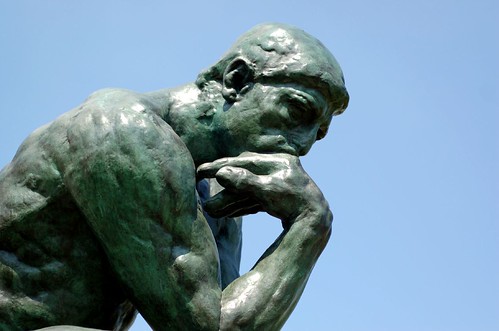
Do you make time in your day to just sit and think?

I know we’re all busy.  We have deadlines to meet, emails to write/respond to, projects to work on, management issues to take care of, errands to run, families to care for, and many many other things that we do on a daily basis.  To make sense of it all, we create daily routines and schedules – wake up, take the dogs out, go for a run, get the kids off to school, respond to urgent emails, get a first draft of that paper done, attend the status meeting, etc.  Lord knows I wouldn’t get half of my work done with my Outlook calendar to remind me when I have to go to a meeting or make a phone call.  Oftentimes, breaking our day up into more manageable tasks is the only way to maintain some level of sanity in our lives.  But what do we lose when we get into routine like this?  Can you make “innovation” part of a routine?

When was the last time you created an Outlook appointment to catch up on your RSS feeds?  When a project deadline gets moved up, what’s the first thing that gets bumped?  How many times have you said, “ya know, I really should write a blog post or comment on some other people’s material tonight, but I’m exhausted and that can wait?”  How often do get outside your individual project “bubble” and make a concerted effort to just go out and learn something new?

When was the last time you just sat down and thought about your project/organization/contract/initiative and wondered?  About the long-term strategy?  About how to improve your team’s morale? About how to become more efficient?  About how to make things better?  About external issues that could positively or negatively impact your work?  When was the last time you came up with a new idea that wasn’t in your job description or SOW?

I had a great conversation recently with one the senior leaders at my company and he told me that’s the one thing that separates the good from the great.  The good worker will meet all their deadlines, crank out high quality products, not ruffle any feathers, show up on time, and do everything that’s asked of them.  The great worker on the other hand, may miss some deadlines and may make some people mad, but they’ll also be the ones coming up with the next great idea.  What was the last actual idea you had at work that wasn’t tasked to you by someone else? Did you tell anyone about it?  Did you act on it?

So, take my advice and carve out 30 minutes of your day to do some thinking.  This could involve:

  • Catch up on your RSS feeds
  • Read the paper
  • Have a team meeting where the only agenda item is “what can we be doing better?”
  • Go out to lunch with someone from a totally different part of the business and learning about what they do
  • Be like Dr. House, find a ball to toss around and think about how to solve a problem
  • Set up Google alerts for issues related to your organization and commit to staying on top of them
  • Create an “If I were King/Queen for a day” list of ideas for your organization
  • Do a Twitter search for your organization/brand and see what others are saying

Can you find time in your schedule to be great?

*Image courtesy of Flickr user Brian Hillegas

Continue reading...

Interested in Being at the Tip of the Spear? Be Prepared for…

April 18, 2010

41 Comments


Image courtesy of Flickr user Percita

Over the last three years, I’ve met a lot of people who are their organization’s social media evangelist, lead, POC, pioneer, ninja, guru, etc., and I’ve met many others who are aspiring to take on that role.  Hell, I even wrote my last post to help those people get started.  While it’s easy to get caught up in all the hype that often follows the people in these roles – the promotions, the raises, the invitations to participate in selective working groups, the personal branding, the ability to make your living using Facebook and Twitter – I’d like to take this opportunity to help balance out the expectations.  The following statements aren’t necessarily good or bad, but they do paint a more realistic picture.

So, if you’re itching to become “the guy” at your organization when it comes to social media, be prepared:

  • To be expected to know EVERYTHING about social media, not only about Twitter, Facebook, and wikis, but also all of the policies, trends, statistics, and laws too
  • To know who else in your organization is also involved with social media and if you don’t, why not
  • To encounter people who assume that because you’re on Facebook or Twitter while at work, that you’re never actually busy with anything
  • To justify the return on investment (ROI) of  all the time you spend using social media
  • To get dozens of emails from people every time a there’s a negative, controversial media article discussing the risks of social media (you should have seen how many people pointed to the Wired article came out showing how terrorists could use Twitter and told me, “see, that’s why we shouldn’t use social media)
  • To be always on, all the time. No matter what meeting you go into, there’s always a chance that you may have to give an impromptu presentation
  • To have people constantly asking you for your thoughts on the latest social media-related email/blog/memo/article/news/interview that came out
  • To justify your existence to your managers when there are organizations who outsource their social media for a few cents per tweet
  • To get inundated with requests like this – “I just read [insert social media link here]. Do you have like 30 minutes to meet with me so that I can ask you some basic questions?”
  • To see your work (even within your own organization) turn up in other people’s work without any attribution
  • To be told that “all this collaboration is great, but what real work have you accomplished?”
  • To change teams and/or organizational alignment at least once

I’ve encountered all of these situations to varying degrees over the last three years, and at times, I’ve felt frustrated, excited, nervous, entrepreneurial, scared, sometimes all simultaneously, but through it all, I’ve always felt proud to be on the cutting edge of changes that need to be made. I’ve never wondered if it was worth it, and I can definitely say that I’ve always felt challenged and stimulated through it all.

If you’re considering being at the tip of the social media spear within your organization, make sure that you’re prepared…for everything.

Continue reading...

Who Owns Social Media? Everyone and No One

March 23, 2010

74 Comments

Over the last few weeks, I’ve been involved in a number of meetings both within Booz Allen and with my clients to discuss social media, and I’ve noticed that more and more organizations are moving beyond the social media experimentation stage. I’m finding that I’m no longer justifying the use of social media, but helping develop the processes, policies, and personnel that will move the use of social media from interesting experiment to a long-term way of doing business.

While your organization’s initial foray into social media may have started with a junior public affairs professional, some webmaster in the IT department, more and more organizations are now trying to figure out how to integrate these social media “pilots” into their long-term strategies and plans.

In one case, I met with a room full of information security professionals. In another, it was a public affairs office. In another, I met with the recruiting office of an agency. In still another, it was a mish-mash of people including public affairs officers, project managers, internal communications, privacy specialists, records management professionals, and senior leadership. Everyone viewed “ownership” of social media differently. Some thought their team should control social media for the entire organization while others felt a more decentralized approach would be more effective. Others wanted to create an integrated process team with representatives from across the organization. The only thing that everyone had in common is the view that their perspective and concerns weren’t getting the attention they thought they deserved.

Internally, we’re going through a similar evolution – in a firm with 20,000+ employees spread across the world and dozens of different business lines and market areas, there’s no shortage of people now looking for ways that social media can help them and their clients. In talking with one of our Vice Presidents the other day, he asked me, “in your opinion, who should own social media here?”  Who was going to be THE person he could reach to with questions? The first answer that came to mind was “well, no one should own it, but there are a lot of people who need to be involved in owning it.”

Then yesterday, I came across this post by Rick Alcantara, “Who Should Control Social Media Within a Company?,” and I couldn’t help thinking that we’re asking the wrong question. If the use of social media is so transformative and paradigm-shifting, and we agree that there needs to be new processes and policies in place to deal with it, then shouldn’t we also be looking at new governance models as well? Why do we assume that social media should (or can) fit into our existing buckets?

The Problem

Organizations traditionally consist of distinct lines of business, teams, branches, divisions, service offerings, etc. This model works great when these teams don’t have to work with one another – IT is responsible for protecting the network, public affairs is responsible for communicating with the public. Great.  But what happens when these teams need to work with one another, need to collaborate with each other?

In some cases, these teams work well together, not because of some formal charter or governance process, but because of the personal relationships that have been made. My team and Walton’s (my counterpart on our IT team) team work well together not because we were told to, but because he and I have a relationship built on trust and mutual respect for each other’s strengths and weaknesses. In other cases, one team works on something and then sends it on to the other team for a formal “chop.” That’s not collaboration – that’s an approval chain. Sometimes, an Integrated Process Team (IPT) is formed to facilitate this collaboration, but those too often devolve into screaming matches or passive aggressive maneuvering, and most IPTs don’t get any real power beyond “making recommendations” anyway.

Just as social media has fundamentally changed the way organizations communicate and collaborate internally, it is also forcing us to rethink the way we govern its use. Maybe social media shouldn’t be “owned” by anyone? Maybe it should be governed in a similarly transformative way?

The Solution

I like what Jocelyn Canfield, owner of Communication Results, has to say at the end of Rick’s post:

“Organizations are best served by collaboration, not control. PR, Marketing, HR, IR, Corp Communications all have a vested interest in effective social media activities, while IT and graphic design can be an important allies in seamless execution. If everyone feels ownership, everyone benefits.”

Emphasis above was added by me – I think everyone has to feel ownership, but they shouldn’t necessarily have ownership. Organizational use of social media impacts everyone across the organization in different ways, from IT security to HR to legal to marketing and ceding “control” to just one of these groups seems to be both short-sighted and unrealistic. What happens when you say that Public Affairs has control of social media, but then IT decides to block all access, citing security concerns? Who resolves that issue? Do the Directors of IT and Public Affairs arm-wrestle? Steel cage death match? Frank and thoughtful discussion?

The answer to who should control social media is everyone and no one. Here at Booz Allen, we’re bringing together both social media leaders and select representatives from across our various teams to form a committee, primarily to ensure that open, cross-team collaboration becomes the norm, not the exception. One of the primary roles for this committee will be to ensure that everyone feels ownership, but that no one is actually given ownership.

How’s this different from an IPT? Well, for starters, I’m proposing that all committee meetings be livestreamed internally where anyone from any team may watch/submit questions. We’ll be blogging internally about what we talk about. Meeting agendas and minutes will be posted to our internal wiki. Everything will be done in the open, encouraging participation, contribution, and truthfulness and discouraging passive-aggressive behavior, back channel discussions, and hidden agendas. The committee’s goal isn’t to determine who owns what; rather, it’s to ensure that everyone understands that no one owns anything.

Organizations should look at social media governance as a way to re-think traditional ownership roles in their organization. When this type of governance is based on open discussion and mutual respect instead of turf-protecting and power grabs, who owns what becomes less important and who KNOWS what becomes more important.

Continue reading...