Tag Archives: cluetrain

The Future of Branding is About Making Friends, Not Ads

May 12, 2012

3 Comments

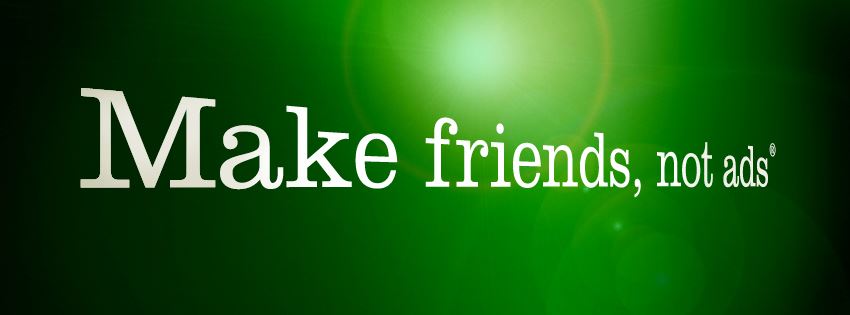
Make friends, not ads.™

That's the message that greeted me when I first opened the Cramer-Krasselt homepage and again when I walked into the lobby for my first interview five months ago. Seemed especially fitting for me as I've railed against traditional advertising ("look at me!! come buy my stuff!! Now! Now! Now!") and traditional PR ("we're the world's leading provider of innovative solutions…") for what seems like forever. Five months after that first interview and six weeks after my first day, I realize that this is much more than a tagline – it's the future of branding. 

For years now, I've been telling my teams, my clients, and anyone else who will listen that they need to read the Cluetrain Manifesto, internalize it, and put it into action. In fact, stop reading this post and do yourself a favor and read the 95 theses included in that book. It has really changed the way I think about business, branding, public relations, and advertising. Now, maybe I'm just naive or I haven't been in the private sector long enough, but I'm seeing signs that this industry is finally starting to get it. Success isn't about creating that one really cool ad, but about creating lasting relationships with your employees, your customers, and the public. 

Here are a few of the recent articles that I've come across that seem to back this up - 

Consumers Are Most Likely to Forgive USAA, Hyatt, Chick-fil-A and Costco Because Of Their Customer-Service Records, According to New Research — But Much Less Likely To Forgive Chrysler, US Airways, Comcast and BofA

"Forgiveness is a valuable asset that you earn by consistently meeting customers' needs, but many companies don't have enough forgiveness stored up to recover from their miscues"

It's Time for Advertising to Take a Lesson (Gasp!) from Public Relations

"They're not your customers; they're your constituents. It's been said often, but it bears repeating: People don't buy brands. They join them. So modern brands must function like political parties, identifying issues, expressing a coherent world view, staging debates and structuring dialogues."

Social Media Is About Cultivating Community, Not Corralling Cattle

"The harder you try to sell, the more you scare — or simply bore — people away. This central truth is not difficult for brands to understand, but for some reason it is hard for them to internalize and act upon. What is first required is to embrace social relationship-building not as the latest marketing fad, or even as a new reality that has been forced upon you, but as a means to revaluate who you are, what you stand for and why you are in business in the first place."
"As agencies, we have to be honest with clients and help them figure out how big or small their footprint should be in an ever-expanding social universe. Are we crafting community strategies with the brands' objectives truly in mind? Marketers should take the time to step back, look at how many things their consumers have in common and build social presences around what their customers care about and why they are connecting."
To a PR guy like me, I'm reading these articles nodding my head saying "ummmm…no shit. I've been saying all of this for years, and Cluetain said it more than a decade ago." Unfortunately, to many, this is still revolutionary thinking in the advertising, marketing, and even PR industries. THIS is the future of branding – it's not about social or mobile or location aware apps or retargeting – it's about fundamentally rethinking what we learned about PR, advertising, creative, and digital in college. It's about making friends, and not Facebook friends or Twitter friends – it's about making real, honest-to-god friends. Friends who will forgive you when you mess up, who will accept a higher price because they understand and empathize with you, who will step up and defend you when you're being attacked, who will pay more because they share similar beliefs, and who will talk about you with their friends and family because they believe in you. 
 
Ads alone aren't going to win you many friends. The most successful brands have already realized this and are using all of the tools at their disposal – advertising, public relations, community relations, creative, CRM – to build real friendships based on mutual trust, integrity, and respect. So, take the advice I see every day when I walk into work and start focusing on making friends, not ads.  

Continue reading...

Public Relations Isn’t the Cherry on Top

April 23, 2012

1 Comment

Photo courtesy of Flickr user SeRVe Photography

"Let's bring PR in so they'll get us some media coverage for the new launch!"

"Let's make sure we have PR look this over to make us sound better."

"Can you have PR develop a plan to make sure the public thinks we're awesome?"

"Our customers keep complaining about our product – can we get PR in here to help drown that out with good stuff instead?" 

"No one is following our Twitter/Facebook/YouTube/Pinterest/LinkedIn/Foursquare account – can PR go get us more fans/followers/likes/subscribers/friends?"

We've all heard these things at one point or another in our career because people continue to misunderstand what public relations is. Despite coming up with new definitions, there continues to be a lack of awareness on the part of our clients, colleagues, and friends about what we actually do and the value that we bring to a business. PR isn't:

  • Some transactional activity that's thought about only after the advertising campaign is created.
  • Something that's brought in after the product is completed and you're gearing up for launch.
  • About getting media coverage.
  • About making the public think your product is the best or that your company is awesome
  • About generating "buzz"
  • Something that's going to cover up bigger issues like customer service or product quality

Public Relations is much deeper than all of this. Public Relations is about – you guessed it – building and maintaining relationships with the public, the very public buying your products, walking into your stores, writing about your company, and telling their friends about their experiences. Those users, demographics, markets, and audiences that you and your analysts always talk about? They're actual human beings. Human beings with very loud voices who can, at moment's notice, make or break your business. Your brand isn't determined by what you say you are, but by what you actually do. It's determined by what your customers see and hear from you every day.

The general public has never had more power than they do right now. Yet, businesses continue to try to take the easy way out clumsily advertising, optimizing, and marketing to these people like they're switches that can be turned on and off if we hit the right levers. What most companies don't realize is that not only is the public more powerful than ever, they are also smarter than ever too. Your customers, employees, and partners want require more than a company talking at them – they want a company that talks with them. They want to talk to actual people. They want companies who care about more than selling more widgets. They want companies who think about something other than their own bottom line. 

Paradoxically, organizations continue to look at public relations practitioners – the very people trained in developing and maintaining these relationships that are more important than ever – as little more than an afterthought. "Oh yeah – we're going to need PR to drum up some media coverage too!" Smart organizations are realizing that marketing and advertising can only take them so far. As my favorite book, the Cluetrain Manifesto says -

"We have real power and we know it. If you don't quite see the light, some other outfit will come along that's more attentive, more interesting, more fun to play with."

Successful organizations are integrating public relations earlier and deeper than ever before. Instead of being a key component of their marketing campaigns, PR is now becoming an integral part of their business plans. This integration, while more time-consuming, has many benefits:

  • Online communities of advocates who promote your brand not because they're being paid or because they have to, but because they truly love your brand
  • Consumers who are more likely to forgive when you inevitably make a mistake
  • Employees who truly love your brand and who act as an extension of your marketing department through their everyday work
  • People who will pay a little more for your product because they trust you
  • Reporters who call you asking for story ideas instead of the other way around
  • Organizations who voluntarily cross-promote your products/services because they trust and respect you
  • People who will leap to your defense in the face of attacks and criticism
  • A corporate voice that sounds authentically human instead of stiff, hollow, and fake
  • Content that is entertaining, informative, and/or useful instead of screaming BUY OUR STUFF NOW!!!!
  • Issues that never become full-blown crises because of the relationships that have been built with employees, customers, media, and partners
  • Corporate counsel that represents the public, not just the bottom line or the shareholder

The public is more powerful now than ever before and good public relations has never been important for your brand. Shouldn't PR become more than a bullet point at the end of the agenda, more than last department to get budget allocations, more than the cherry on top of the sundae? Shouldn't your relationships with the public be a key component of everything you do?

Continue reading...

What Can Advertising Learn From PR When It Comes to Social Media?

September 18, 2011

2 Comments

Two brothers

Image Courtesy of Flickr user cgallent

Public Relations vs. Advertising. Earned media vs. Paid media. Huge budgets vs. tiny ones.  Advertising and Public Relations have been engaged in a love-hate relationships for decades. What’s more effective? What offers better ROI? How should they work together? Should they work together?

For years, advertising has been the big brother in this often tenuous relationship. Whether it’s the massive budgets or the Super Bowl ad campaigns, or the allure of millions of YouTube views, advertising always seems to receive the most attention from an organization’s executives. Public relations, on the other hand, tends to operate more in the background. Need to make budget cuts? Take it from PR. Need a job for that intern? Just give him to the PR team – anyone can do that stuff anyway.

Things are starting to change though. Google became the dominant search engine yet it didn’t air a single TV ad until last year’s Super Bowl. Product launches are now done via strategic leaks, keynotes, and even by purposely keeping your customers away. For the first time in 20 years, Pepsi ditched the 30 second, $4M Super Bowl ad, and instead sunk $20M into the Pepsi Refresh project. What’s going on here? Is this the beginning of the end for advertising?

Of course not. But social media has forced some changes to the advertising industry, whether the old-school likes it or not. And if advertisers want to keep up, they would do well to take some lessons from their PR brethren. In many ways, PR professionals are better equipped for successfully using social media – whether it’s their ability to build and maintain real relationships or their reliance on plain language instead of marketing fluff, PR pros have largely adapted to social media better than than the advertising industry. Here are a few areas where advertising would do well to follow PR’s lead:

  • Advertising should always be looked at as a means to an end, not the end itself. In some ways, advertising itself is the goal (see USA Today’s Ad Meter or the press releases that companies issue about their ads) and has led to a greater focus on views, friends, and Tweets than on sales, revenue, or market share. Your ad campaign isn’t successful because it had a million YouTube views – it’s successful because it’s led to increased sales or customer loyalty or some other actual business objective.
  • Be honest. Consumer trust in advertising is low and continues to fall. When it comes to your company, I’m more likely to trust, well, anyone, other than you. Stop with the boastful, deceptive marketing messages and be honest about your strengths AND your weaknesses. If something didn’t go right, tell me why and what you’re doing about it. Don’t gloss over it and try to blame someone else.
  • 50% of 10,000 > 1% of 50,000. PR hasn’t had the benefit of massive budgets like advertising does. Bashing the public over the head with your ads and hoping for one and two percent returns doesn’t work anymore. Instead, spend more time crafting messages that relate directly with the audience you’re trying to reach.
  • Speak like a human being. I’ll take a line from one of my favorite books, the Cluetrain Manifesto – “Corporations do not speak in the same voice as these new networked conversations. To their intended online audiences, companies sound hollow, flat, literally inhuman.”
  • Show me, don’t tell me. Stop spending millions telling me how fantastic your product or your customer service is and show me. Virgin America’s advertising budget is less than 10% of American Airlines‘ yet Virgin consistently outpaces the traditional carriers in things like customer satisfaction, customer experience, and customer service. I don’t know about you, but I will often pay more money to fly Virgin America, JetBlue, or Southwest just to avoid having to deal with one of the big carriers.

I'll be speaking on a panel on Thursday, Sept. 22nd at Ad Week DC

PR and advertising are going to continue to work together more and more – each would do well to learn from each other. If you’re interested in hearing more about how social media is impacting the PR and advertising industries, I’ll be participating in DC Ad Week where I’ll be joining John Cangany and Karen Untereker for a panel moderated by Robert Udowitz called “What Can Advertising Learn From Public Relations When It Comes To Social Media.”

Continue reading...

Reviewing the Year in Social Media Strategery

December 21, 2010

2 Comments

Social Media Strategery has been around for more than two years now – much much longer than I ever thought I would be able to keep this blogging thing up. As one of my colleagues mentioned to me the other day, two years is an eternity in Internet time, and I’m grateful that I’m still somehow able to come up with posts that people enjoy and/or find useful in their everyday lives.  I’m even more grateful for all of you out there.  This year, you’ve continued to support me in my writing – subscribing, commenting, and sharing my experiences and thoughts with your communities and for that, I can’t thank you enough.

So for everyone who reads this blog regularly – whether you’re a subscriber, reader, commenter, critic, colleague, or friend – thank you, thank you, thank you.  Here are your top five most popular posts on Social Media Strategery from the past year:

  1. Identify the Right People to Manage Your Social Media Initiatives - this has been one of my most popular posts ever, receiving more than 3,500 page views, 26 comments, 400 retweets, and 71 Facebook shares, but more than that, it became a rallying cry for those of us who have grown tired of seeing the wrong people in our organizations get tasked with social media initiatives because of their position, regardless of their skills, experience, or personality.  Hopefully, this post also resulted in at least one or two leaders rethinking their staffing decisions.
  2. Six Villains of Gov 2.0 - One of the most light-hearted posts that I’ve done – this one generated a lot of interest not just because it was fun, but because I think many of us recognized and dealt with these villains before.
  3. I Started a Blog But No One Cared – A post from the very beginning of the year that has remained fairly popular throughout 2010. This post represented another example of people applying old rules to new media. Just because you’ve got a fancy title doesn’t mean anyone cares about what you have to say. Before, we just deleted your emails and you were none the wiser. In the world of social media though, content beats titles any day of the week.
  4. The “Getting Started with Gov 2.0″ Guide – this post was borne entirely out of frustration. I grew tired of sending the same email out over and over again, so I created this post to serve as a resource to direct people to for the fundamentals on Gov 2.0. I can’t tell you how much time this post has saved me (and hopefully some of you) over the last year. Unfortunately, it’s now horribly out of date – looks like I need to create a “Getting Started with Gov 2.0″ Guide – Redux post soon!
  5. Twenty Theses for Gov 2.0, Cluetrain Style – Amazingly, this post is now almost two years old (originally published in February 2009), yet it still gets fairly regular traffic. Enough traffic that it comes in as the fifth most popular post of 2010.  My favorite part of this post is that it yielded many of the key messages that guide my team’s work to this day – from “Social media is not about the technology but what the technology enables” to “Social media is not driven by the position, the title, or the department, it’s driven by the person.”

This blog was a lot of fun for me this year – I was able to write about some pretty important stuff, meet a lot of new people, and most importantly, help make some positive change in the world of social media and our government.  I’m looking forward to writing more, commenting more, and connecting more in 2011 – I hope you’ll all continue to be a part of that for at least 365 more days :) .

Continue reading...

Switch to our mobile site